AI-Powered Sales Automation vs Traditional Methods: What Works Better in 2025?

Let AI summarise and analyse this post for you:
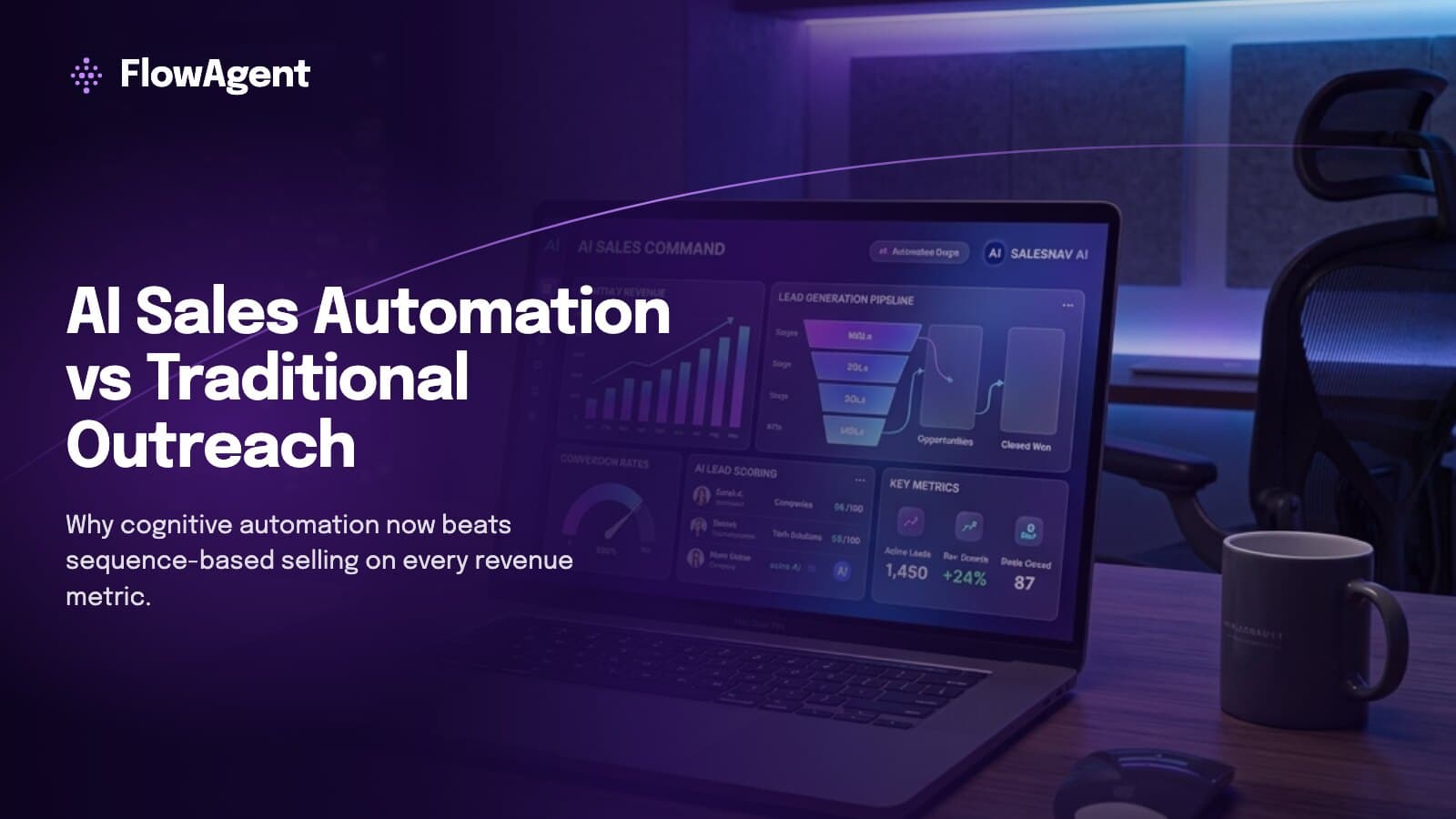
Discover how AI-powered sales automation is outperforming traditional methods in 2025, from lead generation to conversion tracking.
B2B sales automation has undergone a dramatic transformation over the last decade. What was once defined by simple email sequences, CRM triggers, and rigid decision trees is now being entirely rewritten by intelligent, autonomous agents capable of complex reasoning and adaptive decision-making.
As we navigate through 2025, the debate between traditional sales automation platforms and the emerging class of AI Sales Development Representatives (AI SDRs) has settled. The data is clear: cognitive automation dramatically outperforms deterministic automation across every metric that matters to revenue teams.
The Limitations of Traditional Sales Methods
For years, traditional sales engagement platforms promised to scale the output of human SDRs. However, they simply scaled the volume of bad outreach. These legacy systems required human reps to manually stitch together workflows across multiple disconnected platforms (LinkedIn, email clients, CRM, data providers). This structural limitation led to several critical bottlenecks:
- Data Silos and Fragmentation: Crucial prospect intent signals are lost between marketing automation platforms, sales enablement tools, and the CRM.
- The "Mail Merge" Problem: Generic messaging templates that rely on standard variables (like {{Company_Name}}) yield increasingly low conversion rates as buyers become immune to automated spam.
- Wasted Selling Time: Human SDRs still spend over 60% of their day on manual account research, list building, and data entry rather than actually speaking to prospects.
- Linear Scaling: To double your sales output, you previously had to double your SDR headcount—a highly expensive and difficult to manage proposition.
"In 2025, personalization is no longer a luxury—it is the baseline requirement for B2B engagement. AI agents are the only mathematically viable way to scale true 1-to-1 personalization across thousands of accounts."

The AI SDR Advantage: Cognitive Automation
Modern AI SDR platforms fundamentally differ from their predecessors. They don't just execute a pre-defined set of sequential steps; they understand the end goal and dynamically navigate the best path to achieve it.
An AI agent can autonomously research a prospect by reading their recent company 10-K report, analyzing their LinkedIn posts, and reviewing their company's tech stack. It then synthesizes this unstructured data to craft highly contextual, relevant messages that map directly to the prospect's current strategic initiatives.
Measuring the ROI: Conversion Metrics in 2025
Organizations that have fully transitioned from traditional sequence-based outreach to agentic workflows are seeing staggering improvements in unit economics. On average, companies deploying FlowAgent's AI SDRs report a 340% increase in positive reply rates and a 60% reduction in customer acquisition cost (CAC).
By delegating top-of-funnel research, outreach, and initial objection handling to AI, human Account Executives are freed to do what they do best: building high-level strategic relationships, navigating complex organizational politics, and closing deals. The future of sales isn't human versus machine—it's human strategy amplified by machine execution.